“How do you stop the rumours and negative chatter about the change?” That was the question a participant at a recent Living and Leading Change Certificate course asked. The solution–prevent them from starting.
You may be thinking, like many of the participants, nice idea but unrealistic. It’s not possible. It is. The key is to grow and maintain a healthy grapevine.
Every organization has a grapevine. Your grapevine is that informal and usually unsanctioned communication network. It has no clear root, grows rapidly, and embeds itself into every level of the organization. It can either help or hinder your change efforts. Unfortunately for most leaders, managers, and employees it’s the later. A healthy grapevine works for your organizational change efforts, and not against it.
Differences between a Healthy and Unhealthy Grapevine
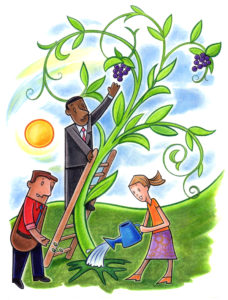 A healthy and an unhealthy grapevine are both informal communication networks. However, a healthy grapevine is grown with frequent, accurate, reliable, and helpful information. An unhealthy grapevine takes root in the absence of information. Once rooted it thrives on rumour, innuendo, and inaccurate information from uninformed sources.
An Unhealthy Grapevine will Undermine your Official Communication Channels
 Think about your organization’s communication network, both formal and informal, as a garden. In a garden weeds left unattended crowd out the flowers and sap the soil of its nutrients. It’s similar with rumours in your organization’s grapevine. Like weeds in an untended garden the rumours drain energy from your change efforts. You also increase the risk your change will fail.
Three features of an organizational grapevine every leader needs to know
-
Spreads information that sticks fast.
People will believe the most outrageous rumour from an unofficial source after hearing it just once. Official information, when given by management, must be delivered six times in six different ways to have a chance of sticking.
2. Doesn’t rely on formal leadership or management authority to communicate information.
Formal leaders make one critical mistake that plants the seed of an unhealthy grapevine. They communicate too little information, too late. The lack of official information creates an information void. One study explored the effects of communication during times of uncertainty. Researchers found in the presence of an information void people adopt information seeking behaviour. Its purpose is to fill the information void and reduce anxiety. In the absence of official communication any information, regardless of its accuracy or source, will fill the void. A void filled with rumour and inaccuracies raises anxiety.
The informal leaders in your organization are in a unique position to respond to the void. The question to ask is, “What information is available for them to fill the void?”
3. Uses active communication.
The most powerful feature of the grapevine is its use of active communication. Active communication is two-way communication. Think about the way your grapevine transmits information. It likely doesn’t use email, or newsletters. It uses conversation.
Contrast this with your official communication. In most of the organizations I work with official communication is passive. Passive communication is one-way communication. Email, memo, and video presentations are all passive communication. Even some town hall presentations are passive communication.
Passive communication increases the risk your message will be misinterpreted. It encourages the spread of rumours, and inaccuracies about your change initiative.
Three Actions to Grow a Healthy Grapevine
1. Acknowledge the existence of an organizational grapevine.
Too many leaders underestimate the power and damage of a unhealthy grapevine. That is a mistake. In the Living and Leading Change Certificate Program leaders learn to conduct an information flow assessment when initiating any change. The purpose of the assessment is to understand the way people get their information. This includes both official and unofficial communication. Leaders discover what works and what doesn’t work in their organization. A key part of the assessment is to understand the breadth and depth of any existing grapevine.
Only when you are aware and understand the power of your grapevine can you begin the process of growing a healthy grapevine.
Editors Note: Learn more about communication during change and how to stop rumours from sabotaging your change efforts with our Living and Leading Change Certificate Course
2. Create and empower a change-recipient centric communication network.
Rumours spread fast because of the large network of people who take part in the conversations. Where as your official communication is usually delegated to one or a small group of people. It’s not enough to target a few select people with the job of communication.
You need to create your own communication network. A communication network that includes the leaders, employees, and managers affected by the change. And represents every level of the organization the change will impact.
The next step is to empower your communication network. Empowering your communication network plants the seeds of a healthy grapevine. But it requires more than some power point presentations in a shared drive and email updates. First, it requires you to trust your managers, leaders, and employees with information. Second, it requires you to ensure accurate, timely, and helpful information is available. You need to communicate even when you believe you have nothing to say. Third, it requires you to start, encourage, and take part in the conversations about the change initiative.
3. Communicate actively.
Think about the way most rumours are spread. Did people talking come to mind? Conversation is the root of every organizational grapevine. It is the conversation people have at their desk, in the cafeteria, at the photocopier, even the washroom. They are usually unplanned, timely, and engaging. I have heard many leaders dismiss these conversations as, “it’s just talk.”
This is a mistake.
Conversation is the most powerful tool in your leadership toolbox. It is also the most feared, undervalued, and as a result under used tool for enabling change. Leaders tell me one reason they don’t use conversation is because it isn’t action. They believe they don’t have time for “all this talk.” The reality is just the opposite.
Change happens through conversation. We use our conversations to frame and re-frame every situation. Our conversations also determine the energy we bring to any situation.
The next time you are about to send an email about an upcoming change or worse to correct a rumour, STOP. Remind yourself, after people get that email they will be talking about it. Research has shown it’s unlikely you will be part of the conversation. You will have lost the ability to ensure your message gets interpreted the way you intended. You also will not have saved any time.
The failure to grow and maintain a healthy grapevine puts your change efforts at risk. It allows the rumours to take root. Once a rumour has taken root it’s almost impossible to get rid of it. You can provide the correct information, but the rumour will continue to linger. After you give the correct information there remains a residual of doubt. The result is you need to spend more and more of your time and energy trying to eliminate the rumours.
Dr. Dawn-Marie Turner
Helping you turn change from a liability to an asset.
Learn more about creating and maintaining a healthy grapevine, bring our Living and Leading Change Certificate Course to your organization.


 I also noticed that my response to the event was determined by whether I focused on the ending or the beginning. And this directly influenced my change readiness. When I focused on the change as the end (of her childhood), I experienced a sense of loss and felt sad. When I focused on the change as the beginning (of her adulthood) and the next phase of our lives, I became more aware and open to the opportunities.