I often hear leaders talk about change management as the people side of project management. This isn’t surprising because for most leaders their first introduction to change management is when launching or implementing a large project.
 The informal surveys and conversations I have had with leaders, and the research all suggest a project-based approach to change is the most common. But, it isn’t the most effective or efficient way to enable organizational change.
Approach Versus Methodology
Before talking further about the advantages and disadvantages of a project-based approach, it is helpful to understand the difference between a change management methodology and your approach to change.
A change management methodology is a structured set of steps for planning and implementing organizational change. Like other methodologies, (e.g., project management, business process re-engineering) it provides a consistent framework for decision-making and guiding the activities of the leaders. For example the DEAM methodology, I developed, is a process based framework that helps leaders apply the essential elements for successful and sustainable change.
Your approach to change is broader and deeper than a methodology. It reflects your values and beliefs about change. It will drive what you focus on throughout the process, the time you allocate, and how you perceive and involve the people affected. Your approach also determines the way you use a change management methodology.
Three disadvantages to the project-based approach to change
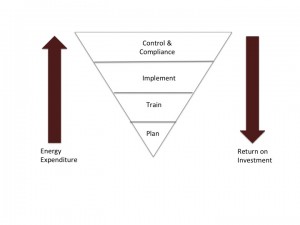
The project-based or as I call it in Launch Lead Live the project-centric approach to change draws heavily from project management. This approach is better than nothing. Another advantage of the approach is that it provides leaders with a structure for managing the Event dimension of change. However, when compared with more developmental and participative approaches (e.g., change-recipient centric) it has three disadvantages. These are:
1. Discourages ownership.
The focus of the project-based approach is on establishing a change leader and one or more project/change teams who act as change champions. This team or teams have been delegated the responsibility for planning, and implementing the change for the organization. The focus on change champions versus wide spread active involvement of the change-recipients absolves people from owning the behaviours and activities needed to achieve the intended outcome.
The result—change in the larger group of change-recipients is inhibited.
2. Minimizes the impact of the Whitespace.
The belief that change can be managed through the completion of tasks and deliverables (i.e. case for change, training) overlooks the impact of the Whitespace. The Whitespace is the intangible space between where people are when the change is announced and where they need to be to sustain the new environment and get a return on your investment. Although people move through a predictable pattern, change is an iterative emergent process. This means there is lots of back and forth. Research has shown leaders who used linear approaches, and who saw change as predictable and sequential tended to fail.
3. Underestimates on the amount of time needed for sustainable change.
Estimating the time needed to complete a project is typically based on scope, resources, and the tasks and deliverables. The problem with using this method to estimate the time needed for change is, people don’t adopt a new behaviour, activity, or work environment by completing a series of tasks or deliverables. Especially when some one else or some other group has defined these tasks and deliverables.
People need time to internalize the need, make sense of the outcome, and navigate the implementation of the new behaviours or activities. Then people (we) need time to enable these new activities to become normalized (new steady state). It’s only when the new environment has become our normal environment that the change will be sustained. For example, the new software or business process is used as intended (without the “tweaks” that turn it into the old), and become,“the way it’s done around here”. The time people need to reach new steady state is usually not accounted for in a typical project-based approach. The failure to achieve new steady state is a contributing factor to change fatigue.
In Executive Change Leader and Living and Leading Change Course I show leaders how to complete a Transition Map. A transition map provides a snapshot of key intangible elements. These intangible elements need to be included in your planning if the new activities and behaviours are to be sustained.
The failure to reach new steady state makes it easy for employees to wait the Event out, or shift back to the old way after the project is completed.
The most effective approach to change is the least used
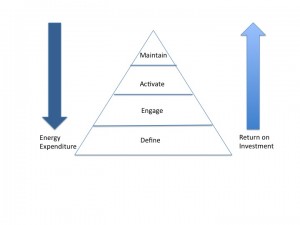
There is an alternative to the project-based approach; it is the change-recipient centric approach. This approach moves beyond a focus on tasks and deliverables and enables leaders to address the intangible elements people need to adopt and sustain change. It is an emergent, participative approach that focuses on building readiness instead of managing resistance.
 Leaders using this approach view the change from the perspective of the change-recipient. They expect, encourage, and create the environment for the active involvement of the change-recipients.
Adopting the change-recipient centric approach to change is in itself a change. It requires new and different leadership and management skills–and like all change it will initially feel uncomfortable. It is also not the common or popular approach. Despite this, I believe, it is worth the effort to adopt this type of approach. Research has shown a participative and emergent approach to change results in higher levels of adoption in the shortest amount of time. It also enables healthier, stronger organizations that thrive because of change and not simply survive in spite of change.
Here are three questions that can help you develop a change-recipient centric approach to change:
- What is the change-recipients’ perception of the change?
- What impact do current organizational structures and systems have on the perception and success of this change?
- What is needed to create and enable the conversations for change?
Helping you move change from a liability to an asset for your organization!
Dr. Dawn-Marie Turner
Portions of this post are excerpts from Launch Lead Live: The executive’s guide to preventing resistance and succeeding with organizational change.
Don’t have your copy. Order it today.
 https://thinktransition.com/wp-content/uploads/2012/08/iStock_000005461904Small.jpg
619
775
dawnmarie
https://thinktransition.com/wp-content/uploads/Turner-Change-Management-logo-1.jpg
dawnmarie2016-07-28 05:08:462025-02-04 17:21:37Oh No! Don’t Yo-Yo: Three Actions for Creating Sustainable Change
https://thinktransition.com/wp-content/uploads/2012/08/iStock_000005461904Small.jpg
619
775
dawnmarie
https://thinktransition.com/wp-content/uploads/Turner-Change-Management-logo-1.jpg
dawnmarie2016-07-28 05:08:462025-02-04 17:21:37Oh No! Don’t Yo-Yo: Three Actions for Creating Sustainable Change
I often hear leaders talk about change management as the people…

The lack of a clear vision is one of the major reasons organizational change initiatives fail. I agree that every organization should have a vision, but every organizational change needs more than a vision, it needs an intended outcome.